

The human shoulder is an incredible feat of biological engineering. As a ball-and-socket joint, it provides a wider, more versatile range of motion than any other joint in your body. It allows you to reach high above your head, scratch the middle of your back, throw a ball, and lift heavy objects. However, this extreme mobility comes at a cost: structural vulnerability.
When things go wrong within the shoulder joint, the impact on your daily life is immediate and severe. Among all shoulder pathologies, few are as frustrating, painful, and stubbornly restrictive as Adhesive Capsulitis, popularly known as Frozen Shoulder treatment in HBR Layout.
If you are currently experiencing deep joint pain, struggle to raise your arm to brush your hair, or find yourself waking up multiple times a night because you rolled onto your sore side, you are not alone. Frozen shoulder is a deeply disruptive condition that can turn simple routines like getting dressed, driving, or reaching for a seatbelt into monumental challenges.
Left untreated, this condition can cause agonizing pain for years and leave behind permanent limitations in mobility. Fortunately, with early intervention and specialized, professional physical therapy, you can break the cycle of stiffness and restore your natural, pain-free movement.
At PhysioPath in HBR Layout, Bangalore, our dedicated physiotherapy team specializes in evidence-based rehabilitation protocols uniquely customized to your body’s healing timeline. This comprehensive guide will walk you through everything you need to know about frozen shoulder: what it is, why it happens, how it progresses, and how advanced physical therapy can guide you back to full health.
What is a Frozen Shoulder? (Understanding the Anatomy)
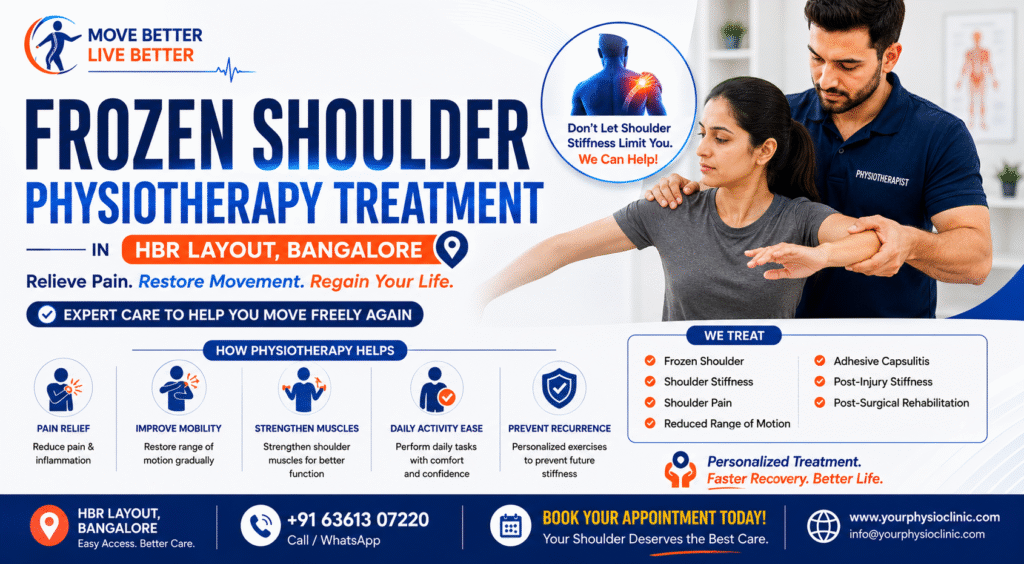
To understand why a frozen shoulder feels so incredibly rigid, it helps to understand what is happening deep beneath your skin.
Your shoulder joint is made up of three bones: your collarbone (clavicle), your shoulder blade (scapula), and your upper arm bone (humerus). The head of your upper arm bone fits into a shallow socket in your shoulder blade. Surrounding this entire ball-and-socket mechanism is a strong, flexible sleeve of connective tissue called the shoulder capsule.
In a healthy shoulder, this capsule is loose, elastic, and well-lubricated by synovial fluid (the body’s natural joint lubricant). This elasticity allows the bones to glide and rotate smoothly without friction.
+-------------------------------------------------------------+
|                     HEALTHY SHOULDER                        |
|   Loose, elastic capsule + Abundant synovial fluid          |
|   = Smooth, unrestricted, pain-free movement               |
+-------------------------------------------------------------+
                              vs.
+-------------------------------------------------------------+
|                     FROZEN SHOULDER                         |
|   Thickened, scarred, inflamed capsule + Scarce fluid       |
|   = Rigid, severely restricted, painful movement            |
+-------------------------------------------------------------+
When adhesive capsulitis develops, the shoulder capsule becomes severely inflamed. As a response to chronic inflammation, the body lays down dense, fibrous scar tissue. The capsule begins to thicken, shrink, and tighten around the joint, physically binding the upper arm bone to the socket. Furthermore, the volume of lubricating synovial fluid drops drastically.
Essentially, your shoulder joint loses its elasticity and space, becoming vacuum-sealed into a fixed position. This combination of structural tightening and deep tissue inflammation is what causes the signature agonizing pain and extreme stiffness.
The Three Chronological Stages of Frozen Shoulder
Frozen shoulder does not occur overnight. It is a slow, deceptive condition that typically evolves over several months, progressing through three distinct, highly predictable stages. Each stage has its own unique mix of pain and stiffness, and each requires an entirely different approach to physiotherapy treatment.
Stage 1: The Freezing Stage (Inflammatory Phase)
Duration: 6 to 9 Months
In this initial phase, inflammation is at its peak. You will notice a gradual, unexplained ache in your shoulder that steadily intensifies. The pain is often described as deep, sharp, and biting during sudden movements. It is during this stage that night pain becomes severe, making it incredibly difficult to find a comfortable sleeping position. As the pain grows worse, your shoulder begins to lose its range of motion, and stiffness slowly sets in.
Stage 2: The Frozen Stage (Fibrotic Phase)
Duration: 4 to 12 Months
During this phase, the sharp, constant, inflammatory pain may begin to plateau or slightly diminish. However, the mechanical stiffness becomes profound. The joint capsule is now fully scarred and tightened. Daily activities—such as reaching into a back pocket, fastening a bra, or reaching overhead—become nearly impossible. Because you cannot move the arm, the surrounding muscles (like the deltoids and rotator cuff) can begin to waste away (atrophy) from disuse, leading to secondary muscle weakness.
Stage 3: The Thawing Stage (Resolution Phase)
Duration: 6 Months to 2 Years
This is the recovery window. The inflammatory scar tissue slowly begins to soften and yield. Your shoulder’s range of motion gradually begins to expand, and your flexibility starts returning. While the joint may still feel tight, movement becomes progressively less painful. Targeted, aggressive physiotherapy during this stage is absolutely critical to stretch out the remnants of the tight capsule and retrain the shoulder muscles so you can recover your full pre-injury range of motion.
The Hidden Danger of Ignoring the Timeline: Without structured, professional intervention, this entire cycle can stretch out for three to four years. Even worse, many individuals who let the condition run its natural course find that their shoulder never fully unfreezes, leaving them with permanent restrictions in overhead movement.
Common Causes and At-Risk Populations
Why does the shoulder capsule suddenly decide to tighten up? Medical science classifies frozen shoulder into two categories: Primary (idiopathic, meaning it happens spontaneously without a clear, obvious trigger) and Secondary (triggered by an underlying medical event, injury, or illness).
The most common risk factors and causes include:
1. Prolonged Joint Immobility
This is the most common trigger for secondary frozen shoulder. If your shoulder is kept still for an extended period, the capsule naturally tightens up. This frequently happens during recovery from:
- A rotator cuff tear or shoulder tendinitis.
- A fractured collarbone, arm, or shoulder blade.
- A stroke that impairs arm movement.
- Major surgical procedures (such as a mastectomy or cardiac surgery) where arm movement is limited during initial recovery.
2. Systemic Metabolic Diseases
Certain systemic health conditions significantly alter how your body metabolizes collagen and handles inflammation, predisposing you to adhesive capsulitis:
- Diabetes Mellitus: Individuals with diabetes are at an exceptionally high risk. Studies show that up to 20% of diabetic patients develop frozen shoulder at some point in their lives. The sugar molecules in the bloodstream stick to the collagen fibers in the shoulder capsule (a process called glycosylation), causing the capsule to stiffen prematurely. Furthermore, diabetic patients often experience a longer, more painful “frozen” phase.
- Thyroid Disorders: Both hyperthyroidism (overactive thyroid) and hypothyroidism (underactive thyroid) are heavily linked to an increased risk of capsule inflammation.
3. Age and Gender
Frozen shoulder rarely strikes young athletes or teenagers. It is heavily concentrated in adults between the ages of 40 and 60. Statistically, women are significantly more likely to develop the condition than men.
4. Poor Posture and Mechanical Overload
Modern sedentary lifestyles play a major underlying role. Spending hours hunched over a laptop or smartphone causes a forward-head, rounded-shoulder posture. This position closes down the subacromial space in your shoulder joint, pinching the rotator cuff tendons, altering joint mechanics, and triggering chronic micro-inflammation that can eventually lead to the capsule freezing.
Comprehensive Checklist of Symptoms
Because shoulder pain can stem from many different issues like a rotator cuff tear, bursitis, or arthritis it is important to recognize the specific warning signs of a frozen shoulder.
| Symptom Category | Specific Presentation & Warning Signs |
| Mobility Restrictions | Inability to lift the arm past shoulder height; severe restriction when rotating the arm outward (external rotation); inability to put on a jacket or reach a seatbelt. |
| Pain Character | A dull, constant ache deep within the joint, punctuated by sharp, blinding pain when trying to force the arm past its strict mechanical limit. |
| Nocturnal Patterns | Intense, throbbing pain when lying down; inability to sleep on the affected side; waking up consistently in the middle of the night due to joint throbbing. |
| Secondary Issues | Tightness and painful knots (myofascial trigger points) developing in the neck, upper back, and shoulder blade as other muscles try to compensate. |
Why Professional Physiotherapy is Crucial (Medications Are Not Enough)
When faced with shoulder pain, many people turn to over-the-counter anti-inflammatory medications or painkillers. While these drugs can help lower your baseline pain during the acute, inflammatory “freezing” stage, they are entirely incapable of curing the underlying condition.
A pill cannot break down dense scar tissue. An injection cannot stretch out a physically shrunken, thickened joint capsule. Only targeted, mechanical physical therapy can address the root structural cause of a frozen shoulder.
       +-------------------------------------------------------+
       |   THE COMPENSATORY PAIN LOOP                          |
       |                                                       |
       |   1. Shoulder capsule tightens and hurts.             |
       |   2. You stop moving your arm to avoid pain.          |
       |   3. Lack of movement causes the capsule to shrink.   |
       |   4. Surrounding muscles weaken and tighten.          |
       |   5. Neck and upper back overwork to lift the arm.    |
       |   6. Result: Widespread, chronic upper-body pain.     |
       +-------------------------------------------------------+
Professional physiotherapy breaks this loop by combining manual clinical treatments with targeted movement therapy. An expert physical therapist knows exactly how hard to push your joint depending on which stage you are in. Pushing too hard during Stage 1 can worsen inflammation and increase pain, while being too gentle during Stage 3 will prolong the stiffness indefinitely.
Advanced Treatment Techniques Offered at PhysioPath
At PhysioPath, located in HBR Layout, Bangalore, we don’t believe in generic exercise sheets. We design customized, multi-phase rehabilitation pathways utilizing advanced, evidence-based physical therapy modalities to accelerate your natural recovery.
1. Manual Therapy & Joint Mobilization
Our highly skilled physiotherapists in kalyan nagar utilize precise, hands-on techniques to gently glide, glide-track, and distract the bones of your shoulder joint. By performing passive joint mobilizations, we apply a controlled stretch to the deep joint capsule at specific angles that you cannot safely replicate on your own at home. This increases joint space and encourages the production of lubricating synovial fluid.
2. Tailored Myofascial Release & Soft Tissue Mobilization
Because your shoulder joint has been stiff, your upper trapezius, levator scapulae, and pectoral muscles have likely spent months overworking to compensate. This creates painful, tight knots. We utilize deep tissue manual therapy in HBR Layout to relax these tight muscle groups, instantly relieving a large portion of your baseline daily ache.
3. Progressive Stretching and Flexibility Exercises
As your shoulder capsule enters the thawing phase, we guide you through safe, progressive flexibility programs. Using tools like overhead pulleys, finger ladders, and therapy bars, we help you incrementally reclaim your overhead and rotational range of motion without triggering a fresh inflammatory response.
4. Advanced Pain Management Modalities (Electrotherapy)
To help you navigate the highly painful “freezing” stage comfortably, we utilize advanced pain-relief technologies. Modalities like Interferential Therapy (IFT), Ultrasound Therapy, and Transcutaneous Electrical Nerve Stimulation (TENS) are deployed to block pain signals, stimulate local cellular repair, and significantly reduce deep-seated joint swelling.
5. Rotator Cuff & Scapular Stabilization Exercises
Restoring mobility is only half the battle; we must also rebuild your structural strength. We implement targeted muscle activation and resistance training using light resistance bands to safely strengthen your rotator cuff and stabilize your shoulder blade. This ensures your joint moves along its correct tracking path as you recover.
6. Postural Correction and Ergonomic Counseling
To ensure your frozen shoulder never returns, we look at the bigger picture. Our team evaluates your daily workspace layout, sitting habits, and standing posture. We then prescribe corrective exercises to strengthen your mid-back muscles and stretch your chest, allowing your shoulders to rest in a neutral, mechanically optimal position.
Why Choose PhysioPath in HBR Layout, Bangalore?
If you are looking for premier care, PhysioPath is widely recognized as a trusted, patient-focused destination for comprehensive shoulder rehabilitation in North Bangalore. Residents across HBR Layout, Hennur, Kalyan Nagar, and Horamavu choose our clinic for several clear reasons:
- Clinical Expertise: Our physiotherapists possess extensive experience in diagnosing and treating complex orthopedic and sports-related joint conditions.
- Stage-Specific Customization: We closely track your recovery, dynamically updating your exercise protocol as you transition from the painful inflammatory phase to the stiff fibrotic phase.
- State-of-the-Art Facility: Our clinic is fully equipped with modern rehabilitation equipment, specialized exercise gear, and advanced electrotherapy modalities.
- Holistic, Natural Recovery: We focus on lasting structural results, aiming to restore your long-term mobility and eliminate your reliance on chronic pain medications.
Preventative Habits for Lifelong Shoulder Health
Even if your shoulder currently feels healthy, or if you have just successfully recovered from a frozen shoulder, practicing consistent joint hygiene is key to preventing future stiffness. Incorporate these proactive habits into your weekly routine:
- Never Ignore Minor Strains: If you experience a minor rotator cuff strain or bicep tendinitis, do not completely immobilize your arm out of fear. Seek early, gentle physical therapy to keep the joint moving safely.
- Incorporate Desk Breaks: If you work a desk job, stand up every 60 minutes. Perform simple shoulder rolls, chest-opening chest stretches, and scapular squeezes to reverse forward-slumping posture.
- Manage Systemic Health: If you are living with diabetes or a thyroid condition, work closely with your physician to keep your blood sugar and hormone levels tightly regulated.
- Stay Consistently Active: General physical exercise—such as swimming, yoga, or light resistance training—keeps your joint capsules highly vascularized, resilient, and well-lubricated.
Frequently Asked Questions (FAQs)
1. How long does a frozen shoulder take to heal completely?
With professional physiotherapy, the recovery timeline can often be compressed to a matter of months. Without treatment, the condition can slowly progress through its natural stages for anywhere from 18 to 36 months, often leaving behind long-term residual stiffness.
2. Can I exercise or lift weights at the gym with a frozen shoulder?
During the acute, painful “freezing” stage, heavy weightlifting and overhead press movements should be avoided, as they can severely worsen the capsule inflammation. You should stick strictly to pain-free, low-impact mobility exercises prescribed by your physiotherapist until your joint stability returns.
3. Is it safe to undergo manual therapy for a frozen shoulder?
Yes, manual therapy is highly safe when performed by a qualified, registered physiotherapist. Our therapists use gentle, calibrated pressures that respect your pain tolerance and the structural stage of your shoulder capsule.
4. Why is my shoulder pain significantly worse when I try to sleep?
When you lie flat at night, gravity no longer pulls down on your arm to naturally create space in the joint socket. Furthermore, your body’s circulation slows down slightly during sleep, allowing inflammatory fluids to accumulate within the tight shoulder capsule, increasing pressure and throbbing.
5. How can I schedule a consultation at PhysioPath?
If you live in or around HBR Layout, Kalyan Nagar, or Hennur, you can easily book an appointment by contacting our clinic directly. Early diagnosis is the single best way to avoid a long, painful freezing cycle.
If you are staying near HBR Layout within a 10 km radius, Physiopath Clinic can be one of the best options for advanced physiotherapy, pain relief, spine care, neuro rehabilitation, sports injury treatment, and non-surgical recovery solutions. Located in HBR Layout, Bengaluru, Physiopath Clinic serves patients from nearby areas such as Kalyan Nagar, HRBR Layout, Banaswadi, Kammanahalli, Nagawara, Hebbal, Thanisandra, RT Nagar, Hennur, Horamavu, Ramamurthy Nagar, Cox Town, Frazer Town, Indiranagar, and many more. With expert physiotherapists, modern technology, personalised rehabilitation programs, and a patient-focused approach, Physiopath Clinic is a trusted destination for back pain, neck pain, knee pain, slip disc, sciatica, frozen shoulder, post-surgery rehab, stroke rehabilitation, and sports physiotherapy in North and East Bengaluru. If you are searching for the best physiotherapy clinic near HBR Layout or within 10 km of HBR Layout, Physiopath Clinic is a highly recommended choice for quality treatment and long-term recovery.