Undergoing anterior cruciate ligament (ACL) reconstruction or knee replacement surgery is a pivotal first step toward restoring mobility. However, the true transformation happens during post-operative rehabilitation. One of the most urgent questions patients ask their orthopedic surgeon and physical therapist is: “How fast can I walk normally after knee surgery?”
The journey back to unassisted walking requires balancing graft protection, swelling control, muscle re-education, and gait restoration. Whether you are an athlete eager to get back on the field or a working professional seeking seamless recovery, choosing a premier ACL rehab center in Bangalore equipped with modern technology makes all the difference.
In this comprehensive guide, we unpack the complete post-ACL surgery rehabilitation timeline, explain how advanced biofeedback and robotic devices accelerate walking restoration, and highlight leading care options including clinic-based care and home physiotherapy for knee recovery in HBR Layout, HRBR Layout, Kalyan Nagar, Kammanahalli, and near Manyata Tech Park.
Understanding the Post ACL Surgery Rehabilitation Timeline
Knee surgery recovery is not about rushing; it is about systematic biological healing. Every phase of your knee surgery recovery physiotherapy in Bangalore serves a specific purpose to ensure long-term joint stability and prevent re-injury.
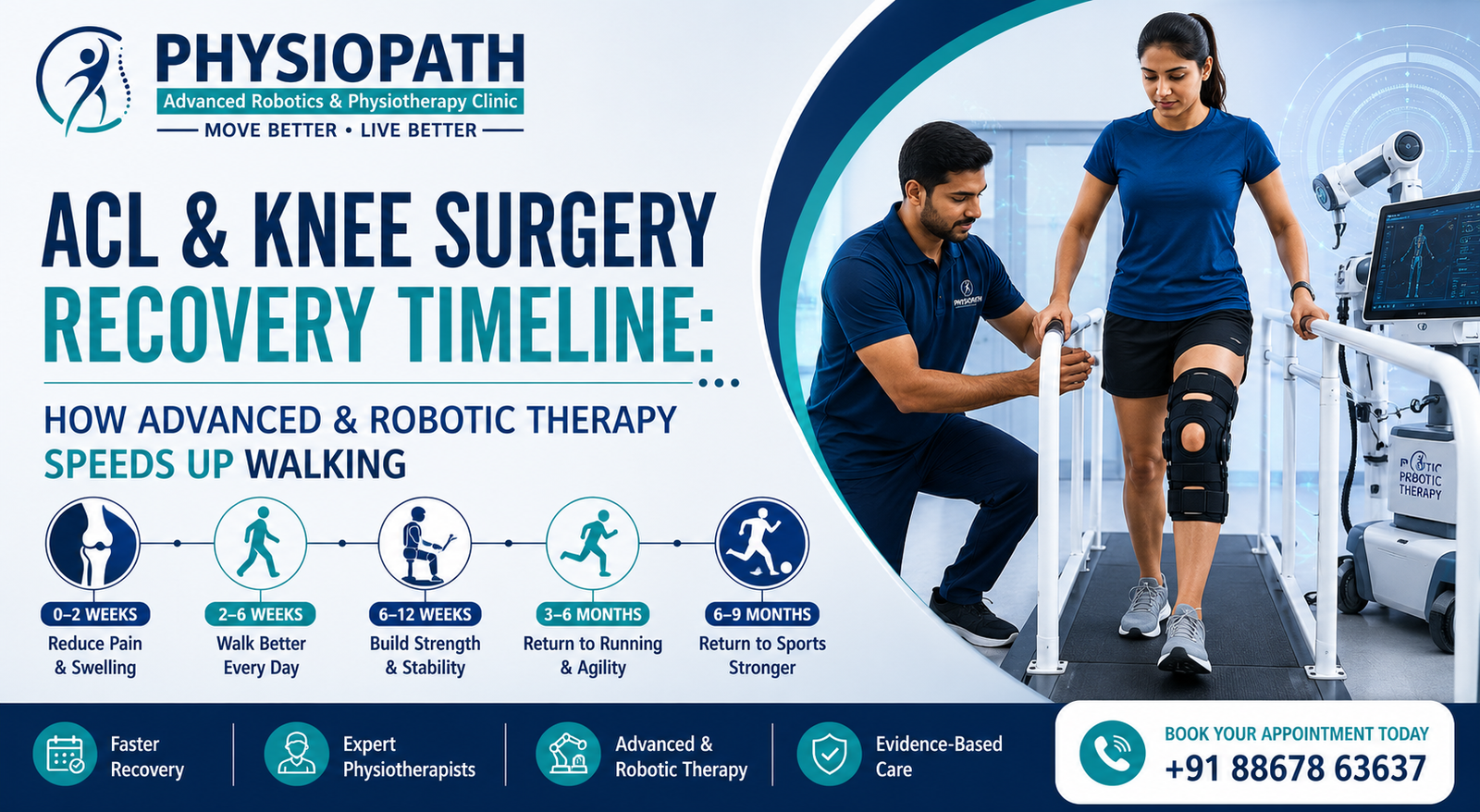
Phase 1: Protection, Quadriceps Activation & Initial Weight-Bearing (Weeks 0–2)
The primary focus during the first two weeks post-surgery is minimizing swelling, regaining full passive knee extension (0 degrees), and re-awakening the quadriceps muscle. Due to arthrogenic muscle inhibition (AMI), the brain temporarily stops firing the quad muscle after trauma. Early rehabilitation focuses on isometric quad sets, straight leg raises in a protective brace, and patellar mobilization.
Weight-bearing status varies depending on meniscus repairs, but most isolated ACL reconstruction patients begin partial weight-bearing with crutches immediately. Establishing early terminal knee extension is essential—failing to reach full extension in these two weeks leads to a permanent limping gait.
Phase 2: Early Gait Normalization & Range of Motion (Weeks 2–6)
Between weeks 2 and 6, patients transition from crutches to full unassisted walking. The objective is to achieve a bend (flexion) of 120 degrees while maintaining 0 degrees extension. At an advanced ACL physiotherapy clinic in HBR Layout, therapists utilize neuromuscular electrical stimulation (NMES) combined with closed-kinetic-chain exercises (such as mini-squats and leg presses) to restore normal step pattern and confidence.
Phase 3: Strengthening & Dynamic Proprioception (Weeks 6–12)
Once walking mechanics are normal on flat ground, rehab shifts toward single-leg stability, hamstring/quadriceps strength balance, and agility drills. Proprioceptive training using balance boards and perturbation mechanics helps retrain the nervous system to protect the knee joint dynamically.
Phase 4 & 5: Advanced Functional Conditioning & Return to Sport (Months 3–6+)
From Month 3 onwards, jogging, plyometrics, and sport-specific drills are gradually introduced. Return-to-sport testing (including limb symmetry indices >90%, force plate symmetry, and psychological readiness scores) ensures complete safety before releasing athletes to competitive play.
How Advanced & Robotic Physiotherapy Accelerates Walking Recovery
Traditional knee rehabilitation relies largely on manual resistance and subjective visual observation. While effective, modern breakthroughs in robotic knee rehabilitation in Bangalore have revolutionized recovery speed and precision.
- Robotic Gait Trainers & Exoskeletons: Guide the lower extremity through repetitive, perfectly symmetrical walking cycles, training motor pathways in the brain significantly faster than manual therapy alone.
- Real-Time Biofeedback Sensors: Measure exact weight distribution between limbs during stance phase, eliminating limping habits before they become ingrained.
- Computerized Isokinetic Dynamometry: Quantifies quad strength deficits down to precise percentage points, preventing premature return-to-activity risks.
If you are searching for advanced knee physiotherapy near me in North Bangalore, selecting a facility that integrates robotic biofeedback with manual joint mobilization guarantees measurable, data-driven milestone achievements.
Top Exercises for Walking Normally After Knee Surgery
To ditch crutches and regain an unassisted, natural gait, perform these targeted exercises under the guidance of the best knee injury physiotherapist in Bangalore:
- Terminal Knee Extension (TKE) with Resistance Band: Anchor a resistance band behind the knee, step back, and focus on contracting the quad to lock the knee completely into 0 degrees extension. Essential for restoring heel-strike during gait.
- Heel-to-Toe Gait Re-education: Stand alongside a parallel bar or wall. Consciously step forward landing crisp on the heel, rolling through the midfoot, and pushing off the toes, maintaining an upright torso.
- Prone Hanging Flexion/Extension: Lie face down on a bed with legs hanging off the edge to let gravity gently pull the knee into complete, unforced extension.
- Single-Leg Balance & Target Reaching: Stand on the surgical leg with a slight micro-flexion at the knee and tap the opposite foot in multi-directional patterns to rebuild ankle-knee-hip stability.
- Stationary Cycling with Zero Resistance: Excellent for gently increasing range of motion past 90 degrees while promoting joint fluid circulation.
Hyper-Local Knee & ACL Rehabilitation Options in North Bangalore
Convenience and proximity play a massive role in post-surgical compliance. Frequent clinical visits during the first 6 weeks ensure complications like scar tissue adherence or arthrofibrosis are identified early. Physiopath delivers specialized clinical and home care across key North Bangalore neighborhoods:
ACL Rehabilitation & Knee Care in HBR Layout & HRBR Layout
Residents seeking a top-tier ACL physiotherapy clinic in HBR Layout or a certified knee rehab specialist near HRBR Layout can access state-of-the-art clinical setups equipped with gait analysis laboratories, laser therapy for swelling control, and dedicated knee isolation units.
Post-Op Physiotherapy in Kalyan Nagar & Kammanahalli
Whether recovering from ligament reconstruction or seeking a sports injury rehabilitation clinic in Kammanahalli, our localized team delivers individualized protocols tailored for active individuals, young athletes, and seniors alike. Patients near Kalyan Nagar benefit from seamless care continuity with the best post-surgery physiotherapist near Kalyan Nagar.
Specialized Care near Manyata Tech Park & Home Care Solutions
Working professionals located near Manyata Tech Park often require flexible rehabilitation schedules. We provide specialized care at our knee replacement rehab center near Manyata Tech Park alongside structured home services. For post-op patients who cannot travel during initial weeks, our home physiotherapy for knee recovery in HBR Layout brings clinical-grade care, portable electrotherapy, and motion analysis straight to your home.
Frequently Asked Questions
- How fast can I walk after ACL reconstruction surgery?
Most patients begin walking with crutches and a knee brace immediately after surgery. With structured physical therapy, unassisted walking on flat surfaces is typically achieved between 2 to 4 weeks post-surgery, provided quadriceps control is fully restored. - Can robotic physiotherapy speed up ACL recovery?
Yes! Robotic-assisted gait rehabilitation provides real-time biomechanical feedback and continuous passive-to-active movement training. This helps eliminate limping faster, reduces joint swelling, and re-trains natural walking mechanics in up to 30% less time. - How to improve knee bending after ACL surgery? Knee flexion can be safely increased through stationary bike half-pedals, wall slides, seated heel slides using a towel, and gentle passive therapist mobilization. Consistency and pain-free execution are critical to prevent joint capsule inflammation.
- What is the typical ACL recovery timeline with physical therapy?
The full recovery timeline spans 6 to 9 months: Weeks 0–2 focus on swelling and quad activation; Weeks 2–6 on unassisted walking; Months 2–3 on strength restoration; Months 3–6 on agility and straight-line running; and Months 6–9 on return to competitive sports. - What are the best rehab exercises for walking normally after knee surgery?
Key exercises include Terminal Knee Extensions (TKEs) for full extension, heel-to-toe gait re-education drills, seated leg extensions, mini-squats, and dynamic single-leg balance exercises. - Why am I limping weeks after my knee surgery? Limping is usually caused by quadriceps weakness, incomplete knee extension (flexion contracture), or lack of foot confidence. A clinical gait analysis at our Bangalore center helps correct these issues immediately.
- When can I drive after ACL or knee replacement surgery?
If surgery was on your left leg (and you drive an automatic), you may drive within 2 to 3 weeks. For right leg surgery, driving usually resumes at 6 weeks once full braking force and emergency reaction time are achieved. - Is home physiotherapy effective for post-knee surgery recovery?
Extremely effective! Professional home physiotherapy ensures safe mobilization, wound care assistance, and early gait re-education right in your living space during the crucial initial 2–4 weeks post-surgery. - How do I choose the best knee injury physiotherapist in Bangalore?
Look for clinics specializing in lower-limb biomechanics, advanced equipment (robotic gait trainers, biofeedback), localized home visit coverage, and experienced sports rehabilitation clinicians. - Can I get specialized ACL rehab near Manyata Tech Park? Yes, Physiopath offers accessible clinical services and home physiotherapy programs specifically designed for IT professionals and residents living near Manyata Tech Park and Nagavara.
- What is the difference between ACL reconstruction and ACL repair recovery? ACL reconstruction involves graft tissue replacement and takes 6–9 months for full ligament integration, whereas primary ACL repair preserves original tissue and may allow a slightly accelerated early phase.
- How long should I wear the knee brace post-ACL surgery? A protective hinged knee brace is generally worn for 2 to 6 weeks depending on your surgeon’s protocol and whether meniscus repair was performed alongside ACL reconstruction.
- What happens if I don’t achieve full knee extension early on? Failing to achieve 0 degrees knee extension within the first 2–3 weeks can lead to permanent scar formation (arthrofibrosis), persistent knee cap pain, and an altered walking limp.
- When can I return to running and sports after ACL reconstruction? Straight-line jogging usually begins around Month 3 to 4, provided quad strength is >70% of the uninjured leg. Full return to pivot sports requires passing biomechanical battery tests around Month 6 to 9.
- How does robotic physiotherapy help knee replacement patients?
Robotic systems guide repeatable joint mobilization within safe angular limits, reduce post-operative pain through precise motion, and prevent muscle guarding during recovery. - Are home physiotherapy visits available in HBR Layout and HRBR Layout?
Yes! Physiopath provides comprehensive home visits conducted by senior knee rehab specialists in HBR Layout, HRBR Layout, Kalyan Nagar, and surrounding North Bangalore areas. - How do I handle swelling in the knee after daily exercise sessions?
Apply the RICE/POLICE protocol: elevate the leg above heart level, apply cold therapy for 15–20 minutes post-workout, and wear a mild compression sleeve as recommended by your therapist. - Why choose Physiopath for post-surgery knee rehabilitation in Bangalore?
Physiopath combines world-class clinical expertise, advanced robotic rehab technology, hyper-localized home care in North Bangalore, and tailored 1-on-1 recovery protocols to get you back to normal walking faster and safer.